Examples
Worked walkthroughs and a notebook backed by the runnable scripts in examples/. Each guide breaks down a live script step by step alongside its build-time output, so every number and snippet matches the current code.
Note
Running the examples locally
Install the examples extra from the repository root and run any script directly:
pip install -e ".[examples]"
python examples/example_stim_circuit.py
The notebook (coherent_noise_d3.ipynb) also requires matplotlib and Jupyter.
Timings shown below are from a 12-core laptop; Stim’s own sampler appears in a
few guides only as an independent reference. The test suite also runs the
Stim circuit, noise modes, and coherent noise scripts.
Learning path
Follow the three tracks below in order if you are new to deltakit-maestro,
or jump straight to the topic you need.
1. Fundamentals
Start here to learn the core MaestroBackend sampling API, how circuit noise
is parsed and routed between Maestro’s Stabilizer and Matrix Product State
simulators, and how to attach a custom maestro.NoiseModel.
Goal: Sample, seed, decode, and sweep a Stim circuit without Deltakit.
simulate(),compile_sampler(), andsinter.collectBit-for-bit noiseless check against Stim and manual PyMatching decoding
~1 s · examples/example_stim_circuit.py
Goal: See how MaestroBackend splits gate noise from circuit noise.
noise_params_from_stim()andstrip_gate_noise()All four
noise_typemodes ('pauli','coherent','full','none') and overrides
~2 s · examples/example_noise_modes.py
Goal: Configure per-qubit calibration, asymmetric readout, and crosstalk.
Seed a
maestro.NoiseModelfrombuild_noise_model()and override hot qubits/couplersDirect sampling with
MaestroCompiledSamplerand Sinter sweeps withMaestroSinterSampler
~6 s · examples/example_custom_noise_model.py
2. Scaling & Code Families
Move from single circuits to multi-worker Sinter parameter sweeps and across Deltakit’s topological and qLDPC code families.
Goal: Benchmark a d=3 rotated surface code under SI1000 and coherent noise.
Deltakit
RotatedPlanarCode+SI1000Noise4-worker
sinter.collectsweep and coherent vs. Pauli twirl comparison
~12 s · examples/example_surface_code.py
Goal: Run repetition, planar, toric, and bivariate bicycle codes unchanged.
Graphlike DEM decoding with PyMatching
Non-graphlike
[[72,12,6]]qLDPC decoding with BP-OSD
~20 s · examples/example_deltakit_codes.py
3. Coherent Noise & MPS Precision
Use Maestro’s Matrix Product State (MPS) engine to simulate non-Clifford coherent over-rotations and verify convergence with bond dimension χ.
Goal: Measure the coherence penalty over a matched Pauli twirl.
noise_type="coherent"on MPS vs.twirled_circuit()on StabilizerLogical error ratio and detection-event ratio decoded with the twirl’s DEM
~3 s · examples/example_coherent_noise.py
Goal: Choose and verify the MPS bond dimension χ for coherent runs.
Noiseless truncation check (
simulation_type=MPS,noise_type="none")Convergence sweep showing how under-resolved χ inflates coherent rates
~50 s · examples/example_bond_dimension.py
Visual Notebook
An interactive Jupyter notebook with publication-ready figures comparing coherent
over-rotations (χ=32) against their Pauli twirl and SI1000 across noise
strengths p, plus per-detector rate maps and event-count distributions.
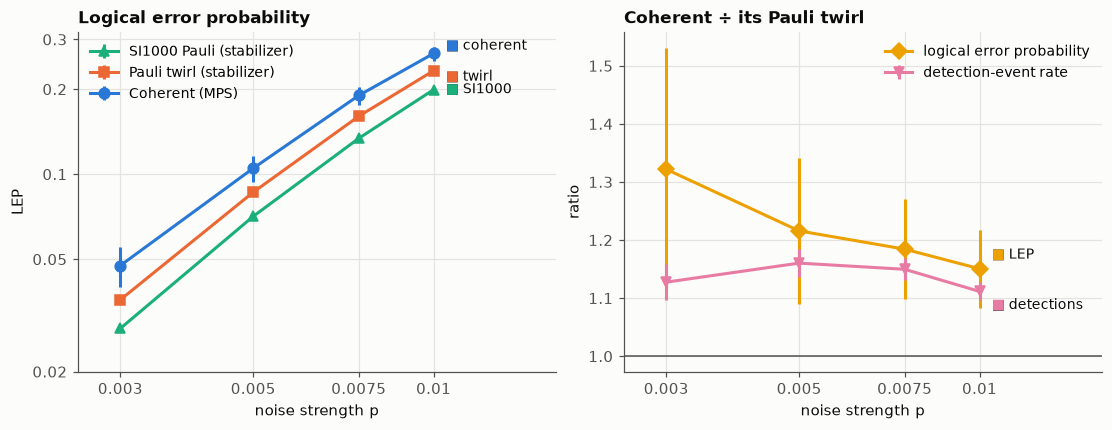
Coherent noise on the d=3 surface code against its Pauli twirl and SI1000.
~40 s · examples/coherent_noise_d3.ipynb