Coherent noise
Real gate errors are often coherent: small, systematic over-rotations whose
amplitudes can add up across gates before a measurement collapses them. No
Clifford simulator can run them, so decoder studies usually replace them by
their Pauli twirl, which has the same per-gate infidelity but no coherence.
noise_type='coherent' runs the over-rotations themselves, on Maestro’s matrix
product state.
What 'coherent' simulates
Each gate’s depolarizing is replaced by an isotropic coherent over-rotation of
ε = 2·arcsin√p about a body diagonal of the Bloch sphere, after every gate, on
every qubit it touches. The signs are drawn once per qubit per shot, so a
qubit’s rotations add coherently between measurements. Idle, reset and readout
noise stay as they are. 'full' keeps the circuit’s gate noise too and adds the
over-rotation to it.
The strength p is the coherent= keyword, by default the circuit’s two-qubit
gate rate p_2q.
Comparing against the twirl
The comparison that isolates coherence is a coherent run against its own Pauli twirl, decoded with the same detector error model:
coherent = backend.simulate(noisy, shots=300, noise_type='coherent')
twirl = backend.simulate(backend.twirled_circuit(noisy, noise_type='coherent'), shots=100_000)
The twirl runs on Pauli frames, so it can take far more shots than the MPS run. On the d=3 rotated surface code, coherent noise gives about 11–16% more detection events than its twirl, and a higher logical error probability at every strength tested:
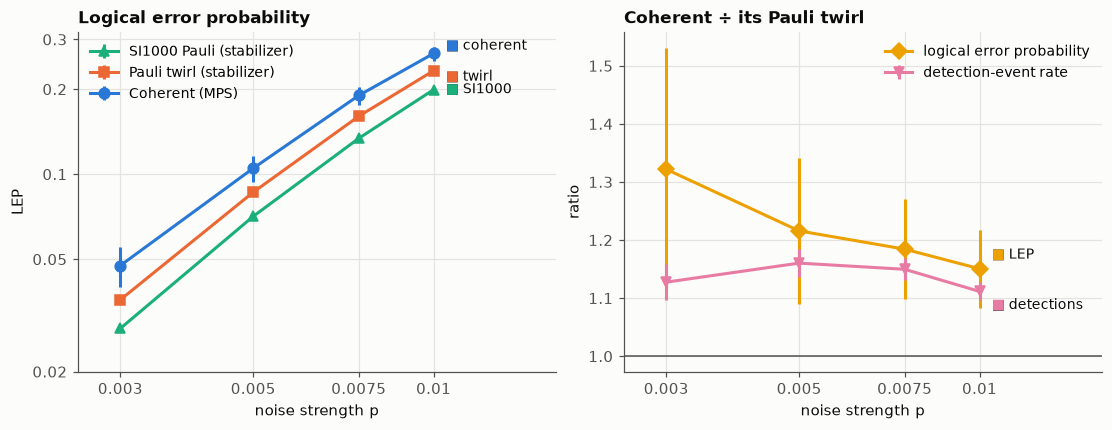
The d=3 rotated surface code, 3 rounds: coherent noise (MPS, χ=32, 800 shots a point) against its Pauli twirl and SI1000 (stabilizer, 200,000 shots each), all decoded by PyMatching with the twirl’s detector error model. From the coherent noise notebook.
The excess is spread across the code. Most detectors fire more often under coherent noise, the mid-circuit rounds most of all, and shots with no detection event at all become rarer:
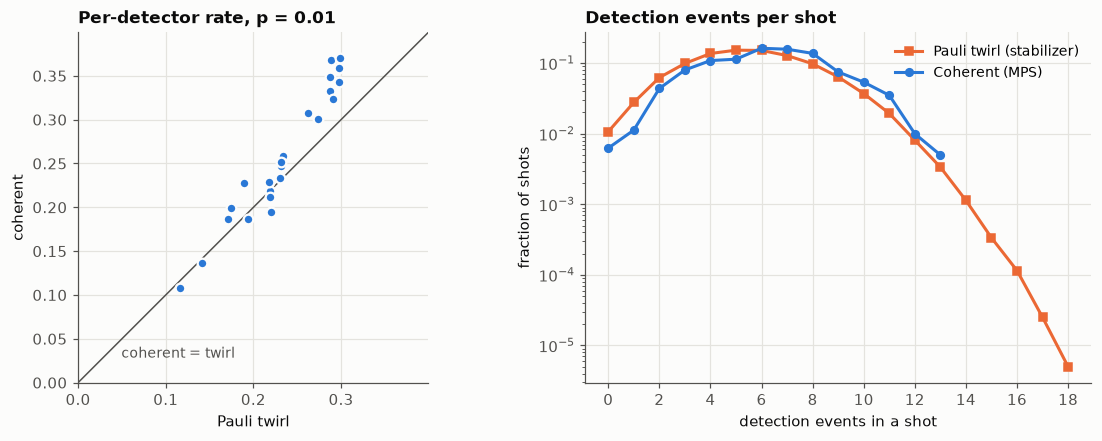
Per-detector rates and detection events per shot at p = 0.01. The coherent histogram ends where its 800 shots run out, near 10⁻³.
The detection-event ratio is the sharper measure here: the logical error ratios carry wide error bars from the few coherent shots. Too small a bond dimension inflates the coherent effect, so check it first: see Bond dimension.
Calibration against SI1000
'coherent' keeps SI1000’s idle, reset and readout noise and replaces only the
gate noise, so it is close to SI1000, but not equal. maestro.NoiseModel sets
one coherent strength per qubit, applied after every gate whatever its arity.
With the default coherent = p_2q, an SI1000(p) circuit gets an over-rotation
of infidelity p after each single-qubit gate (SI1000 has p/10 there) and on both
qubits of each two-qubit gate (about 2p in total, where SI1000 has p). That
over-counts gate noise.
Measured on the d=3, 3-round memory at p=0.01 (logical error probability, PyMatching):
Noise |
LEP |
|---|---|
SI1000 Pauli (stabilizer) |
0.1990 ± 0.0009 |
Pauli twirl of |
0.2330 ± 0.0009 |
|
0.270 ± 0.016 |
So 'coherent' and 'pauli' at the same p differ by about 17% in LEP from
strength alone, before any effect of coherence. To isolate coherence, compare
'coherent' against its own twirl, as above. A per-gate-type coherent strength
in Maestro would close the rest of the gap.