Bond dimension
Coherent runs need a matrix product state (MPS), with bond dimension χ set by
MaestroBackend(max_bond_dimension=) (default 32). Too small a χ truncates the
state, which shows up as extra detection events, the same direction as the
coherent effect being studied. So χ has to be checked, not assumed.
Checking χ
Noiseless check. Run with
simulation_type=MatrixProductStateandnoise_type='none'. Every detector must stay silent, so any detection event is truncation error. It needs no reference and a few dozen shots. It relies on the pinned type: withfixed_backend=False, Maestro would sample this Clifford circuit on Pauli frames and the check would always pass.Coherent convergence. Coherent noise needs more χ than the noiseless check. Double χ until the result is unchanged within its error bars.
import maestro
from deltakit_maestro import MaestroBackend

MPS = maestro.SimulationType.MatrixProductState

for chi in (4, 8, 16, 32):
    mps = MaestroBackend(simulation_type=MPS, max_bond_dimension=chi)
    dets = mps.simulate(noisy, 200, noise_type='none', seed=1).detection_events
    print(chi, dets.any(axis=1).mean())   # shots with a detection event: 0 once χ is enough

for chi in (8, 16, 32, 64):
    backend = MaestroBackend(max_bond_dimension=chi)
    dets = backend.simulate(noisy, 400, noise_type='coherent', seed=1).detection_events
    print(chi, dets.mean())               # raise χ until this stops changing
On the rotated d=3 code at p=0.01, the noiseless circuit is exact from χ=8, but the coherent detection-event rate is 0.294 at χ=8, 0.272 at χ=16, and 0.263 at χ=32 and 64, against 0.236 for its Pauli twirl. At χ=8 truncation adds about as much as the coherent effect itself:
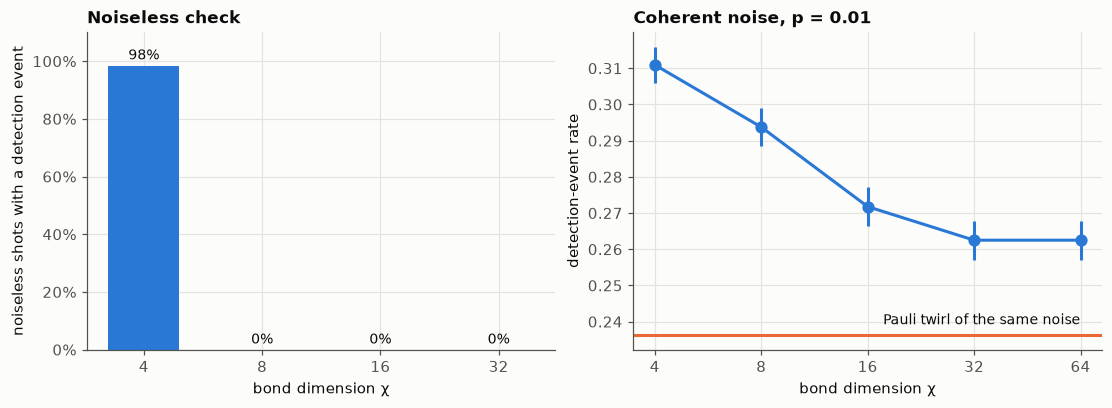
Both checks on the rotated d=3 code, SI1000(0.01), 3 rounds. From the coherent noise notebook.
example_bond_dimension.py runs both checks on a rotated and an unrotated code.
Which codes are practical
Only the rotated d=3 code is practical. Checked with the noiseless test above (3 rounds, SI1000(0.01) circuits):
Code |
Qubits |
Smallest exact χ |
Cost |
|---|---|---|---|
Rotated planar d=3 |
17 |
8 |
~1 ms/shot |
Unrotated planar d=3 |
25 |
> 64 |
~0.9 s/shot at χ=64, still 75% of shots wrong |
Unrotated toric d=3 |
36 |
> 32 |
~1 s/shot at χ=32, every shot wrong |
Rotated planar d=5 |
49 |
> 32 |
~1.5 s/shot at χ=32, every shot wrong |
These noiseless runs have no noise to spread over cores, so they take as long on one. Renumbering the qubits row by row from their coordinates did not help; it made the rotated d=3 code need χ=64.